Wired vs Wireless Topologies
Evaluating Power over Ethernet (PoE) stability against the flexibility of battery-operated Wi-Fi camera arrays in dense residential and commercial environments.
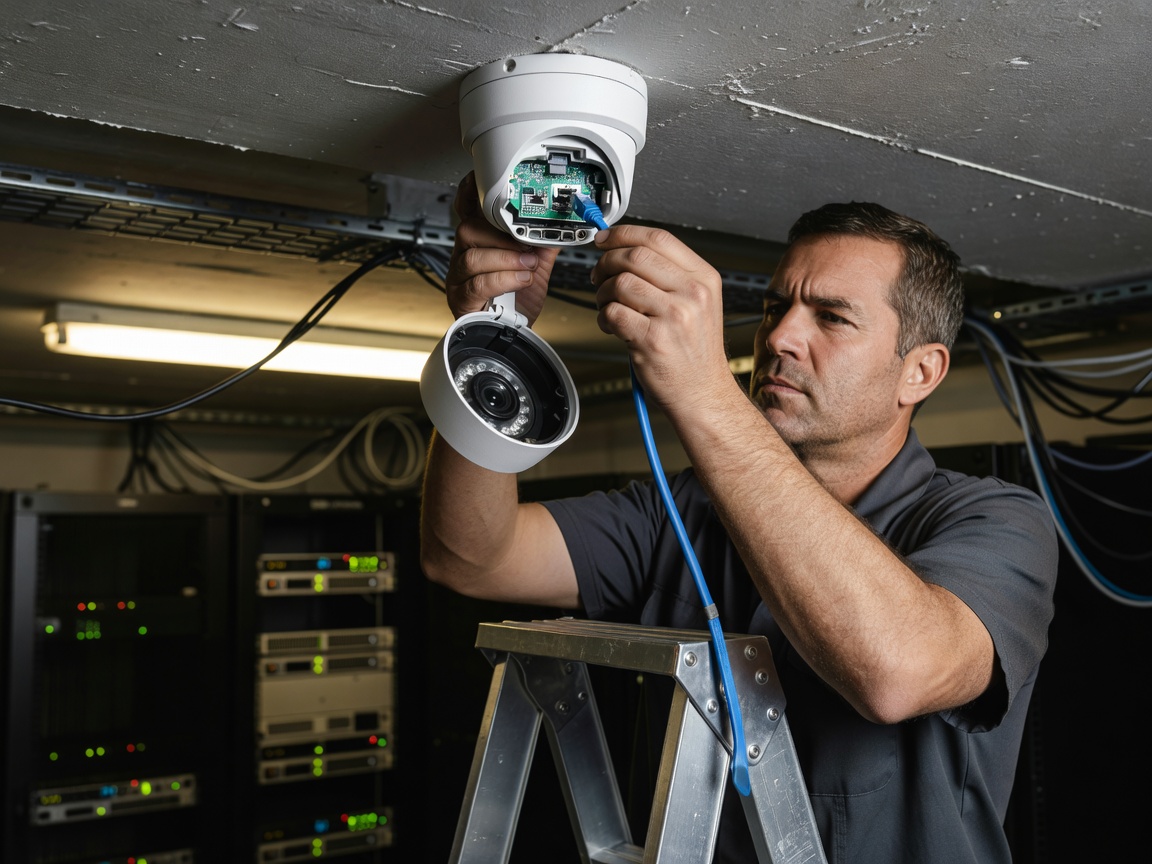
The foundational decision in deploying any modern security infrastructure is selecting the communication and power topology. The industry broadly divides into two categories: hardwired systems—typically utilizing Power over Ethernet (PoE) or coaxial cables—and wireless systems, which rely on Wi-Fi protocols for data transmission and either dedicated power lines or onboard batteries for power.
Understanding the technical trade-offs between these two approaches is critical for building a resilient, low-latency surveillance network that meets specific security requirements without creating unmanageable maintenance overhead.
The Anatomy of Wired Systems (PoE & BNC)
Wired security cameras physically connect to a central recording hub, such as a Network Video Recorder (NVR) or Digital Video Recorder (DVR). The modern standard is IP (Internet Protocol) cameras powered by PoE switches. A single Category 5e or Category 6 (Cat5e/Cat6) ethernet cable delivers both data networking and electrical power.
Advantages of Wired Architecture
- Uncompromised Reliability: Wired connections are immune to RF interference, Wi-Fi jamming attacks, and network congestion caused by other smart home devices. If the cable is intact, the stream remains stable.
- Continuous 24/7 Recording: Because they are continuously powered via the network switch, wired cameras excel at round-the-clock recording. They do not need to rely on motion-triggered wake states to conserve battery life.
- Higher Bitrates and Resolution: Gigabit ethernet can support the massive data throughput required for uncompressed 4K video feeds at 30 frames per second across multiple channels simultaneously.
Disadvantages to Consider
- Complex Installation: Routing Cat6 cables through attics, crawlspaces, and exterior walls requires significantly more labor. Professional installation is often necessary, increasing the initial capital expenditure.
- Fixed Placement: Once a camera is mounted and wired, relocating it requires running new cable.
The Flexibility of Wireless Systems
The term "wireless" in the surveillance industry can be slightly misleading. It typically refers to wireless data transmission (Wi-Fi), but power sources vary. "Plug-in wireless" cameras still require a standard AC wall outlet, while "wire-free" cameras run entirely on rechargeable lithium-ion batteries or small solar panels.
Advantages of Wireless Deployment
- Rapid Deployment: Without the need to pull cables through walls, a multi-camera wireless system can be mounted and configured in under an hour.
- Renter-Friendly: Wire-free battery cameras require minimal drilling, making them ideal for temporary installations or rental properties where structural modification is prohibited.
- Ecosystem Integration: Many consumer-grade wireless cameras integrate seamlessly with broader smart home ecosystems, leveraging existing wireless access points for communication.
Inherent Limitations
- Bandwidth Constraints: Multiple high-resolution cameras streaming simultaneously over a 2.4GHz Wi-Fi band will quickly saturate the network, leading to dropped frames, latency, and compression artifacts.
- Battery Maintenance: Wire-free cameras employ PIR (Passive Infrared) sensors to sleep when inactive. They wake, record, and transmit only when motion is detected. If placed in high-traffic areas, batteries can drain in weeks rather than months. Furthermore, the first crucial seconds of an event are sometimes missed during the camera's "wake-up" latency period.
- Vulnerability to Interference: Thick brick walls, metal siding, and competing wireless signals can drastically reduce the effective range and reliability of the data transmission.
Architectural Comparison Matrix
| Feature | Wired (PoE IP Camera) | Wireless (Battery / Wi-Fi) |
|---|---|---|
| Video Quality | Consistently high; low compression required | Variable based on signal strength; higher compression |
| Recording Style | Continuous (24/7) to local NVR | Event-triggered (Motion) to conserve power/bandwidth |
| Vulnerability | Physical cable tampering | Wi-Fi jamming, password breaches, dead batteries |
| Latency | Near-zero (sub 100ms) | Noticeable delay (1 to 5 seconds depending on network) |
Hybrid Deployments: The Best of Both Worlds
In enterprise and advanced residential setups, a hybrid topology is often the most pragmatic approach. Security architects secure the perimeter and primary exterior entry points using hardwired PoE cameras to guarantee 24/7 recording of critical zones. Wireless cameras are then utilized as supplemental coverage for interior spaces, detached garages, or temporary surveillance needs where running a cable is cost-prohibitive.
Ultimately, the choice between wired and wireless dictates the foundational capability of the entire system. While wireless offers immediate convenience, a hardwired PoE system remains the gold standard for robust, professional-grade security infrastructure.